


Avoiding UX Traps: A Frontend Developer with a Passion for Product Design
With nearly two decades of experience in software development, Krystian’s journey has taken him from early web builds to becoming a frontend specialist. In this interview, Krystian shares how he builds strong partnerships with product designers to create better user experiences, and shares his candid reasons why team leadership wasn't a career path he found utmost rewarding.
Tell us more about the beginning of your career.
My interest in web development started when I was a teenager, building my first HTML sites. It led me to study Computer Science and Econometrics. I landed my first commercial job at a small software development agency. They were developing their own CMS and building sites on top of it. That was over 17 years ago.
I stayed there for about two years before moving to an electronics distribution company. I started out with PHP there too, but eventually pivoted to specializing in frontend to support their e-commerce platform. We used Angular and had some legacy code, but for the new features, I was building in React. We also did a ton of SEO optimization.
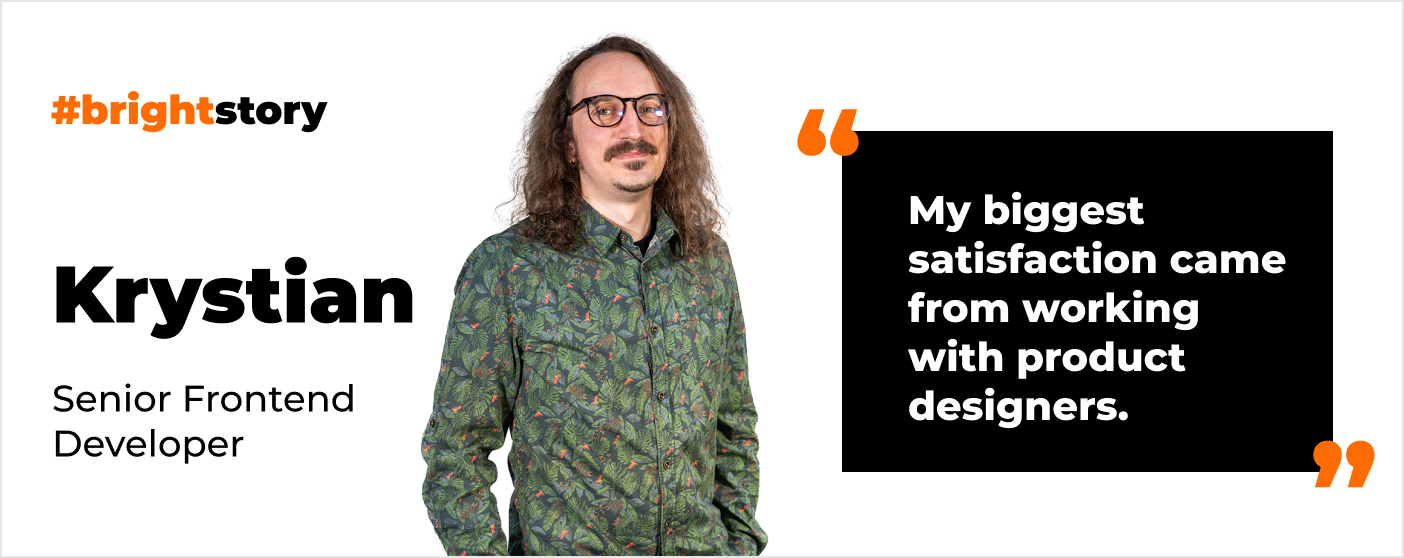
After a few years, I took on my first management responsibilities, though leadership itself wasn’t my main driver. My biggest satisfaction came from working with product designers because I already felt confident knowing a lot of UX traps that product teams can get themselves into, so I wanted to help avoid that.
And how was this cooperation with product designers going?
At first it wasn't easy because, in many situations, a developer has a chance to contribute to the design when it’s quite late – the design is done, the backlog is full, and here comes the frontend developer having some suggestions.
This was especially hard when many people in the team already felt quite attached to the design. That was something that took time to develop – this relationship with designers and including me, a developer, earlier in the process with some feedback at brainstorming or mockup stages. We slowly moved to that, so I felt I could also contribute and there was no bad blood with the designers.
You mentioned that the team leader role wasn't the most rewarding path for you. Why?
Although I got pretty positive feedback from my team members, I’m truly not sure if I could be a good leader when challenges arise. I managed a really great team full of professionals eager to do the job well. But what if I encountered a demotivated team? I’m not sure if I would know how to handle that. I’m not comfortable giving corrective feedback. I am also not sure if I am assertive enough, or if I could handle conflict – I’d rather avoid it. So I guess I lack lots of traits that a leader should have.
Leaders aren’t necessarily born with these traits. Maybe you could still improve in these areas?
Maybe, yes. Naturally, there were areas of leadership I cherished, such as getting the chance to cooperate with other departments, and bringing different worlds together to build a digital product. Also, as I said, I really liked working with the team I had. I just think I wasn't tested in harder scenarios where I would need to step out of my comfort zone.
What perspective can a frontend developer bring to product design?
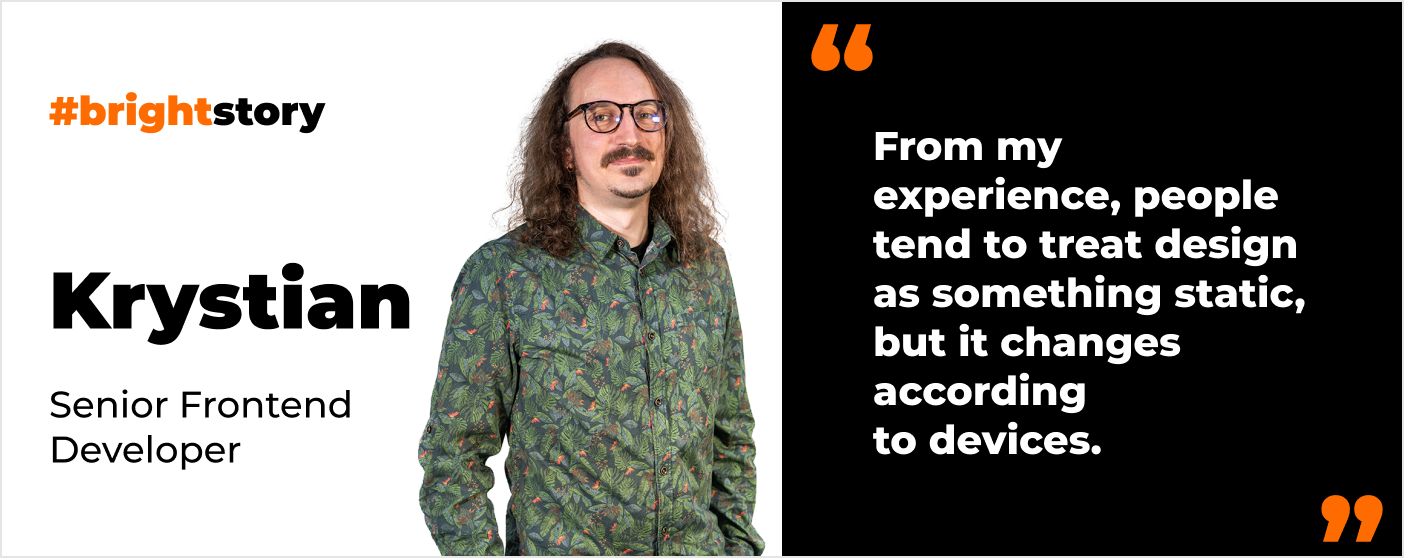
One example is that developers should remind the team that an interface will be visible on very different devices, especially on mobile. We should remember about protective zones for clickable elements. A frontend developer should always have in mind how each element will behave on mobile with small and bigger resolutions. From my experience, people tend to treat design as something static, but it changes according to devices, and that’s something a frontend developer should put stress on.
Also, adding an extra voice to the conversation (like a developer’s) might help to sometimes go beyond the rules for the user's benefit.
What do you mean by that?
I once read about Formula 1 teams helping to optimize the space in surgery rooms. When the driver goes into the pit bay, everyone from the team is placed for maximum optimization so the driver can leave as fast as possible. This precision is something of value for hospitals as well.
I think that naturally, we should follow the rules, like we all know that a hamburger menu must be on mobile, and a shopping cart should have a cart icon and probably be on the right side of the page. But sometimes, we still need to bend the rules, just like they started to challenge the status quo in that special hospital environment to make it more efficient.
For example, if we see from data that users are scrolling to a feature which is far down, or maybe they need to visit a few pages to get to it, maybe it’s a sign to put it high up on the homepage to make it more accessible. Even if this feature might not make sense on the homepage at first sight. If it gives value to users and is popular, we might as well go for it. The hierarchy of information is one thing, but convenience is another.
Frontend developers can’t bring Formula 1 driver experience, but they can add a unique perspective to the table in product teams.
How do you feel at Bright Inventions?
I’ve had the chance to build quite a range of products, and right now I’m working on a solution for the tourism industry. Although the web is still closest to me, I learned React Native here, and this flexibility regarding tools, product and responsibilities suits me.
I am particularly happy that my recent project just reached a stage close to my heart, where we are working on the user experience for the web solution. I love contributing to that, working side by side with the product designer. We are at a stage where we work with mutual trust, sharing our ideas and suggestions, and I love that I get to build relationships like this at Bright Inventions.
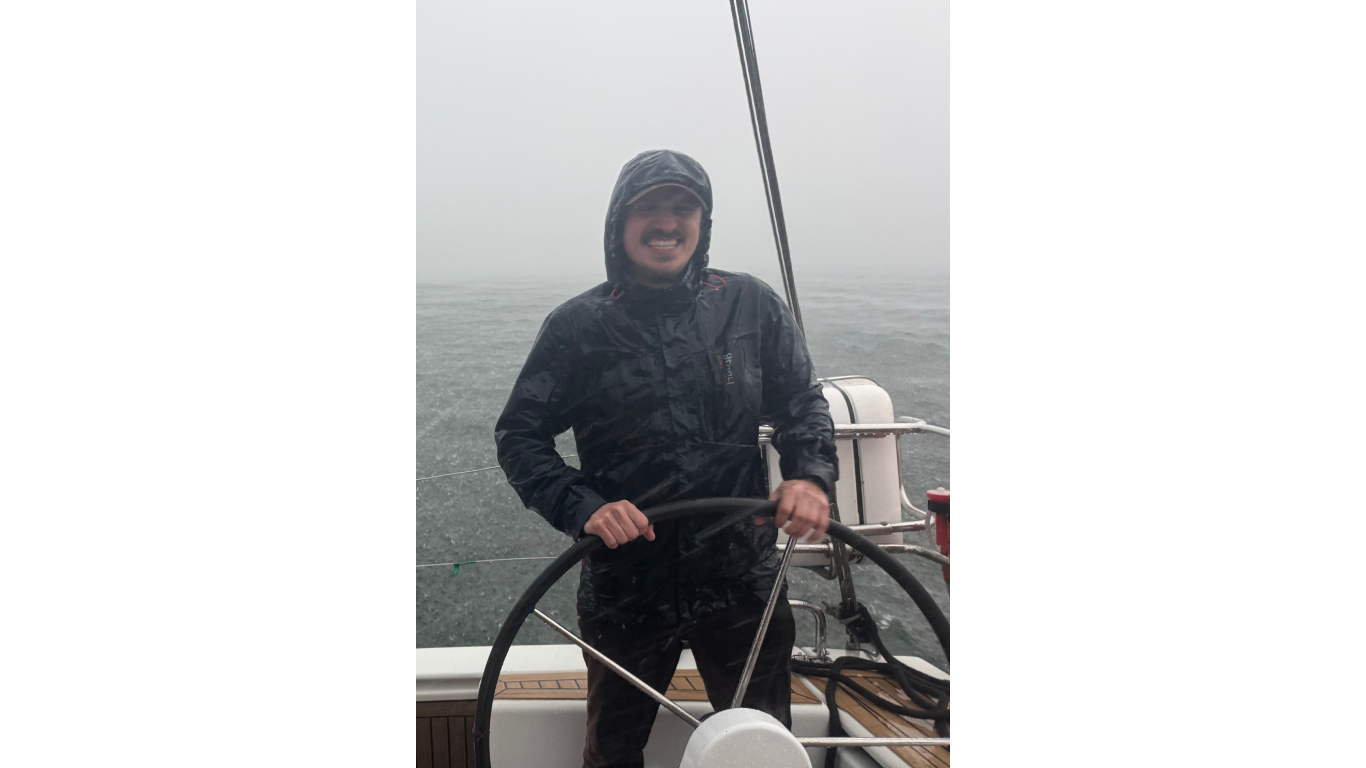
Did you enjoy our rainy sailing during the recent team retreat?
Yes, very much. I was actually hoping for a stronger wind so it would toss the sailboats around more. You know, a little more endorphins wouldn’t hurt anyone and would definitely help us bond even more.
But there was even a storm at some point? It wasn’t enough for you?
I guess my expectations were even higher. 😁